Tramp metal detection

TripTronic 3000

Tramp metal detection for Australian ore.

How the TripTronic 3000 works: detection, trip, Flag Drop Marker and controller reset (66 s, tap to unmute)
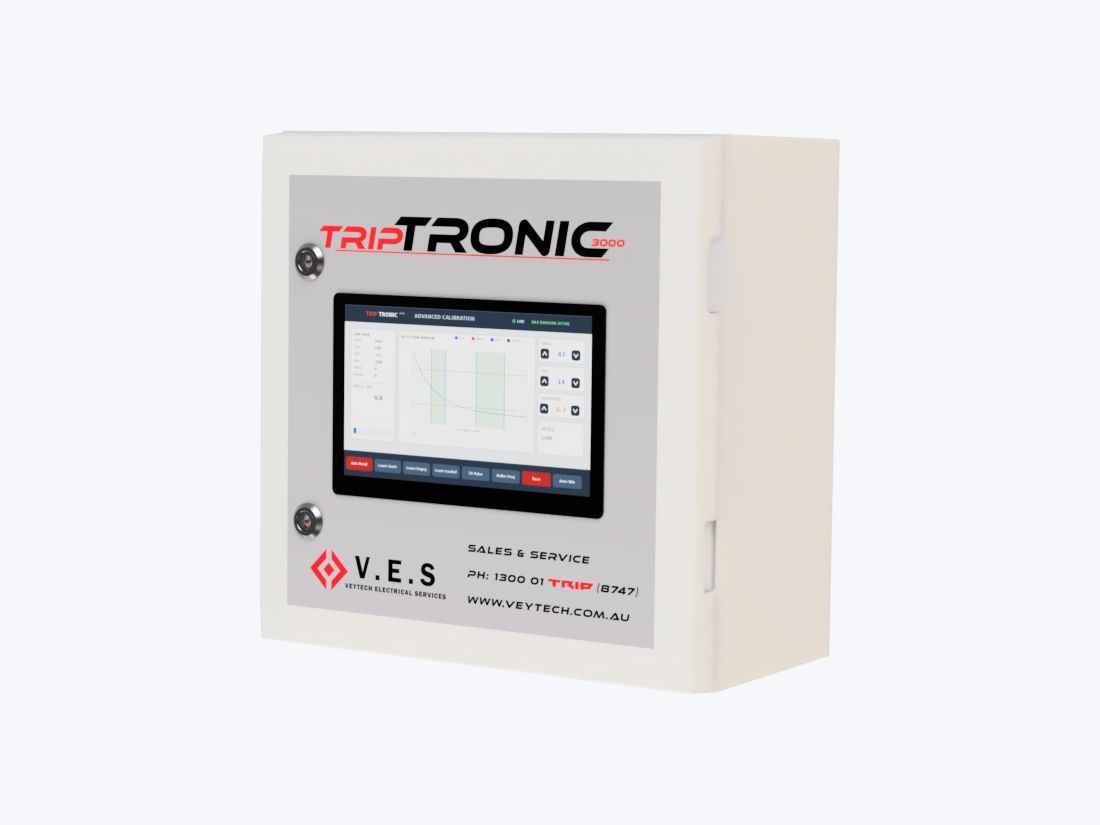
Controller with 10.1″ touch screen in an IP66 enclosure
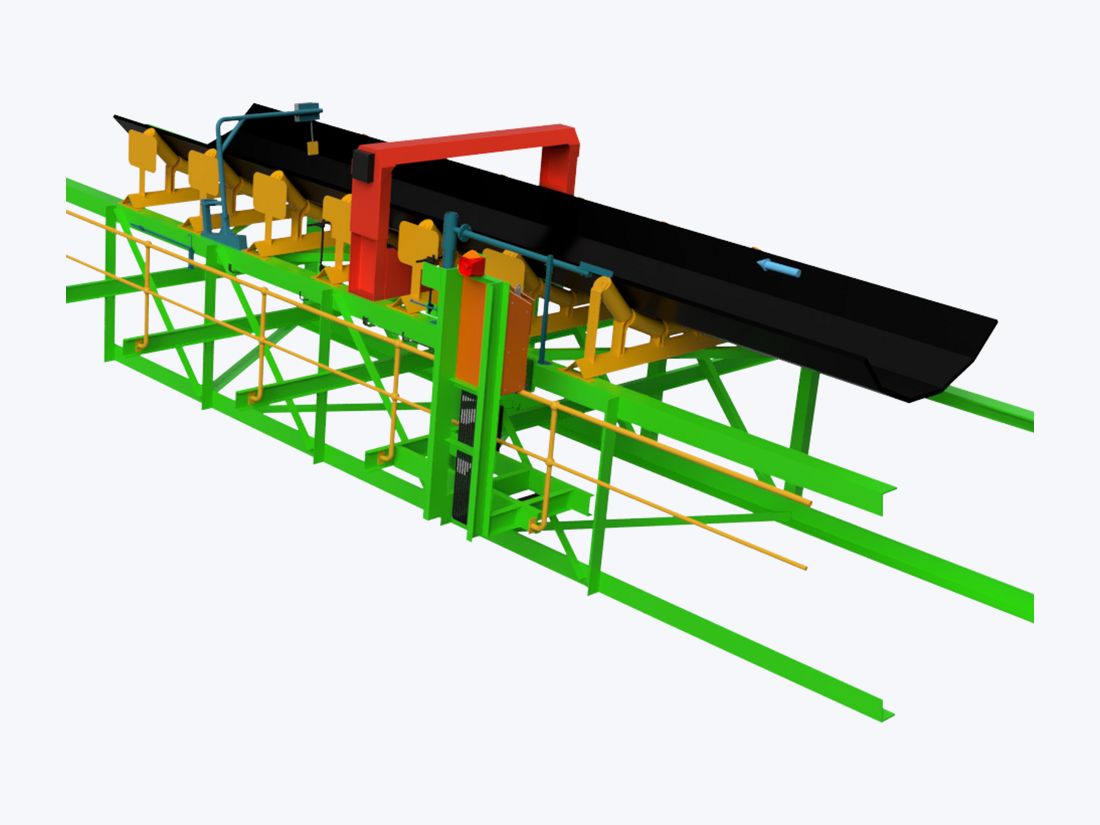
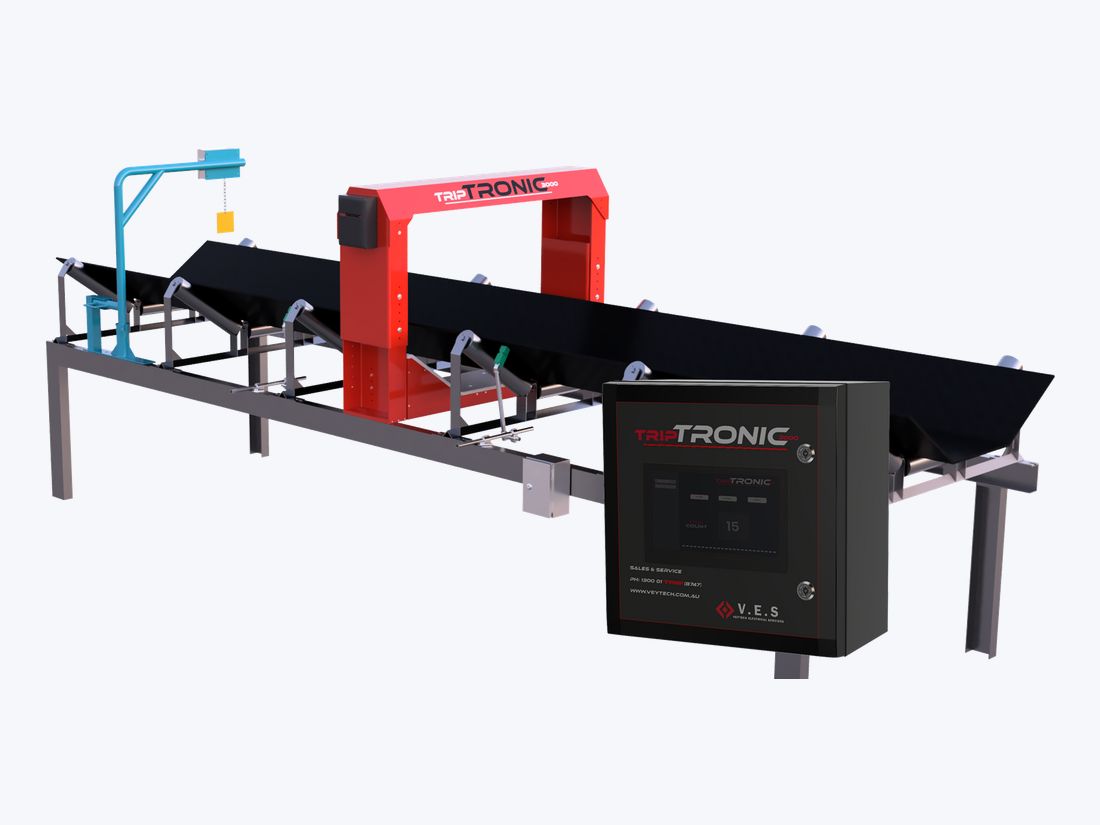
Complete system on a typical conveyor
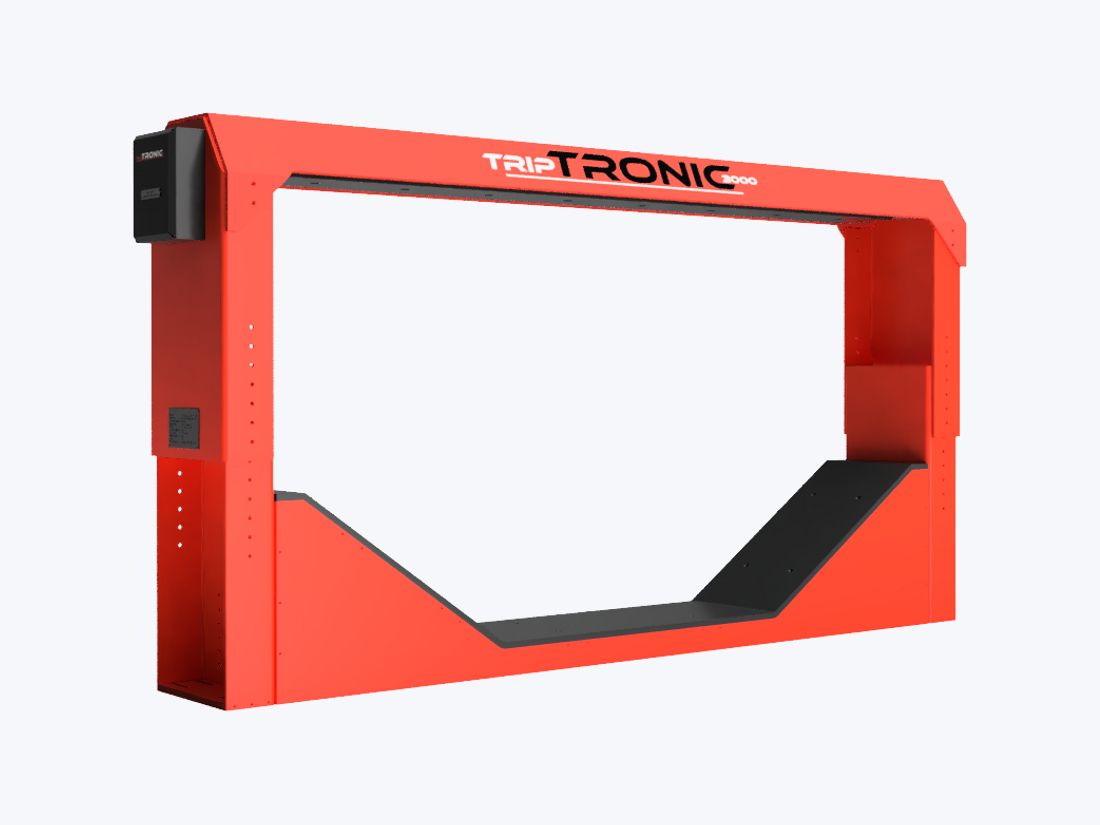
TMD frame with transmitter and receiver coils
Detector frame installed in conveyor structure
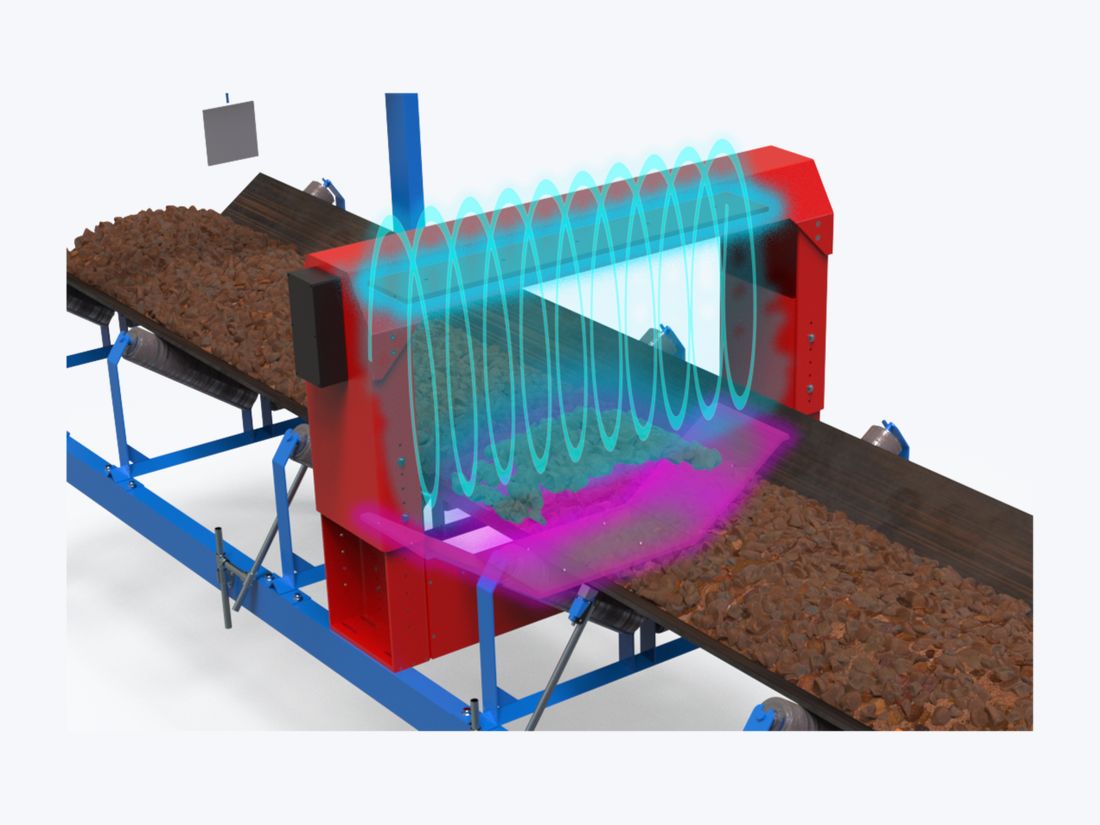
Pulsed field between the coils and the ore stream
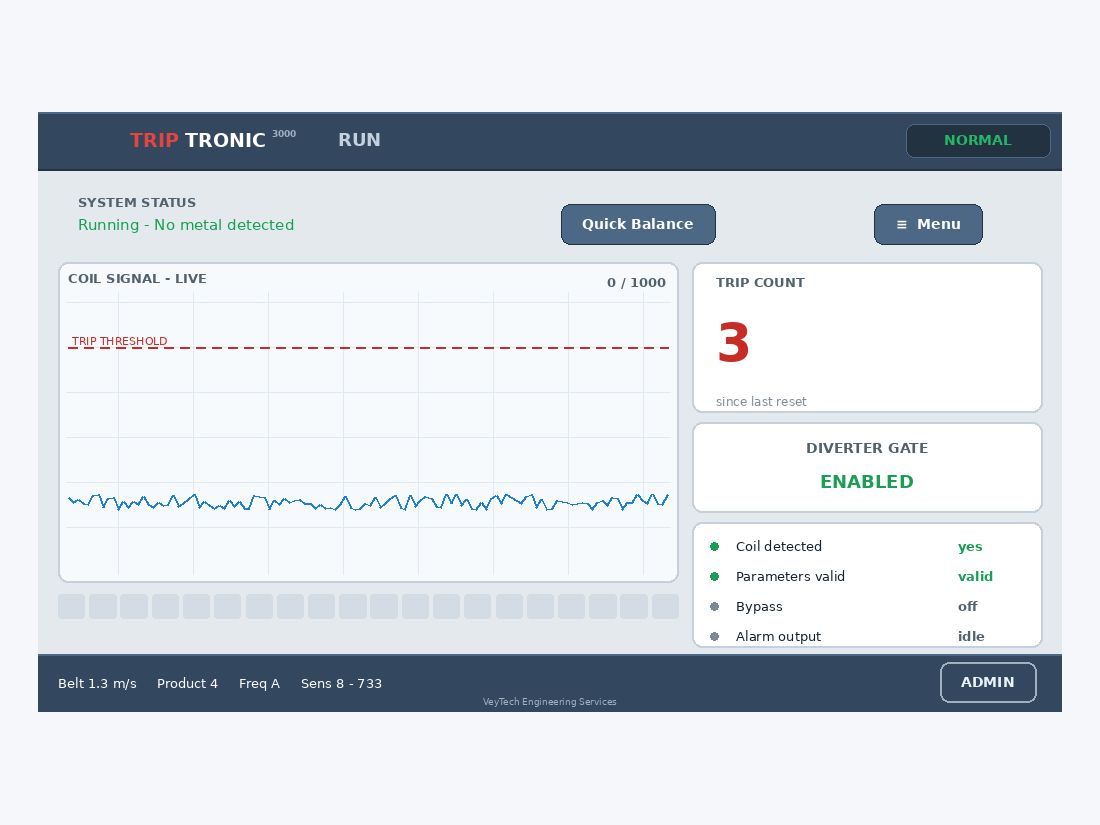
Run screen: live signal against the trip threshold
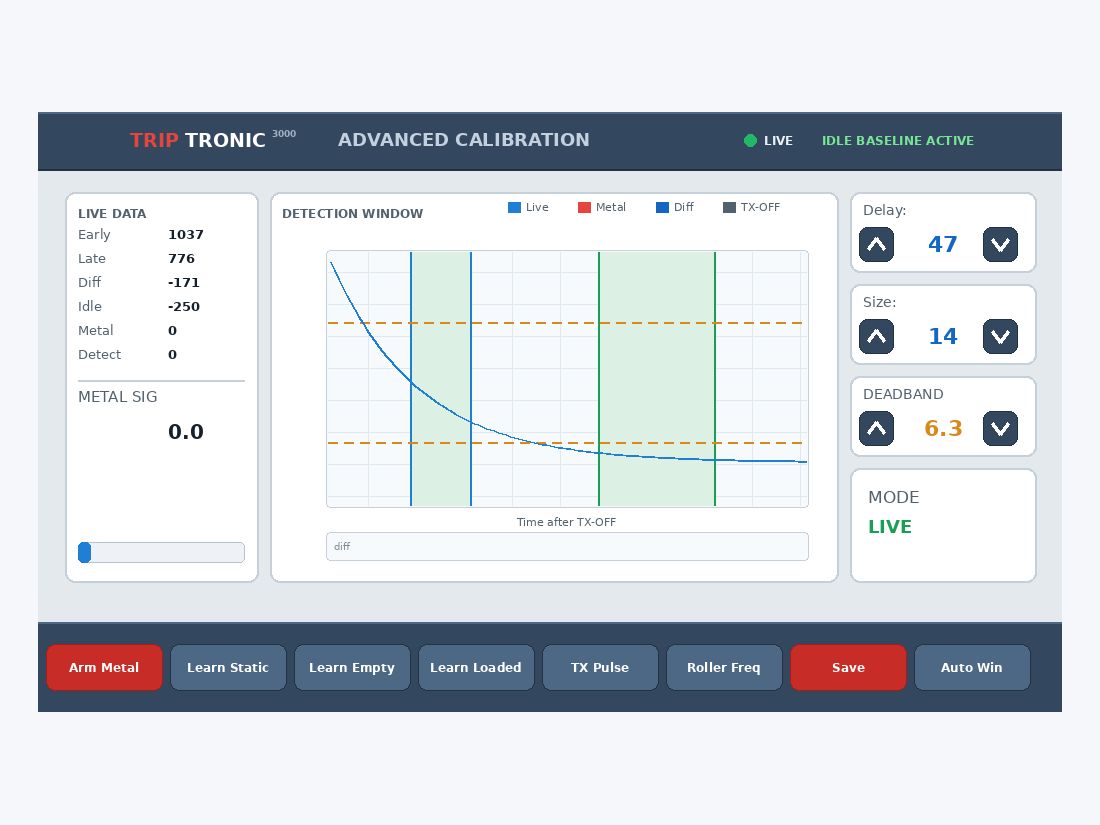
Advanced Calibration screen: detection window and live data
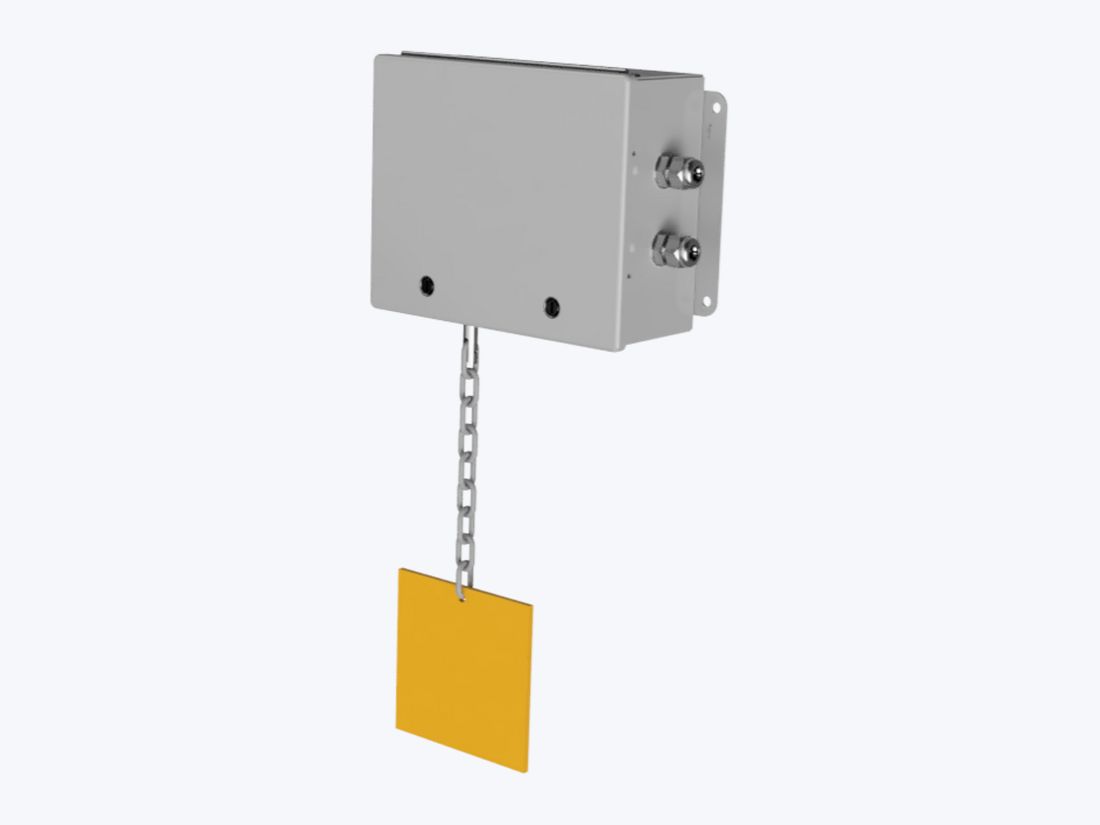
Flag Drop Marker
Flag Drop Marker
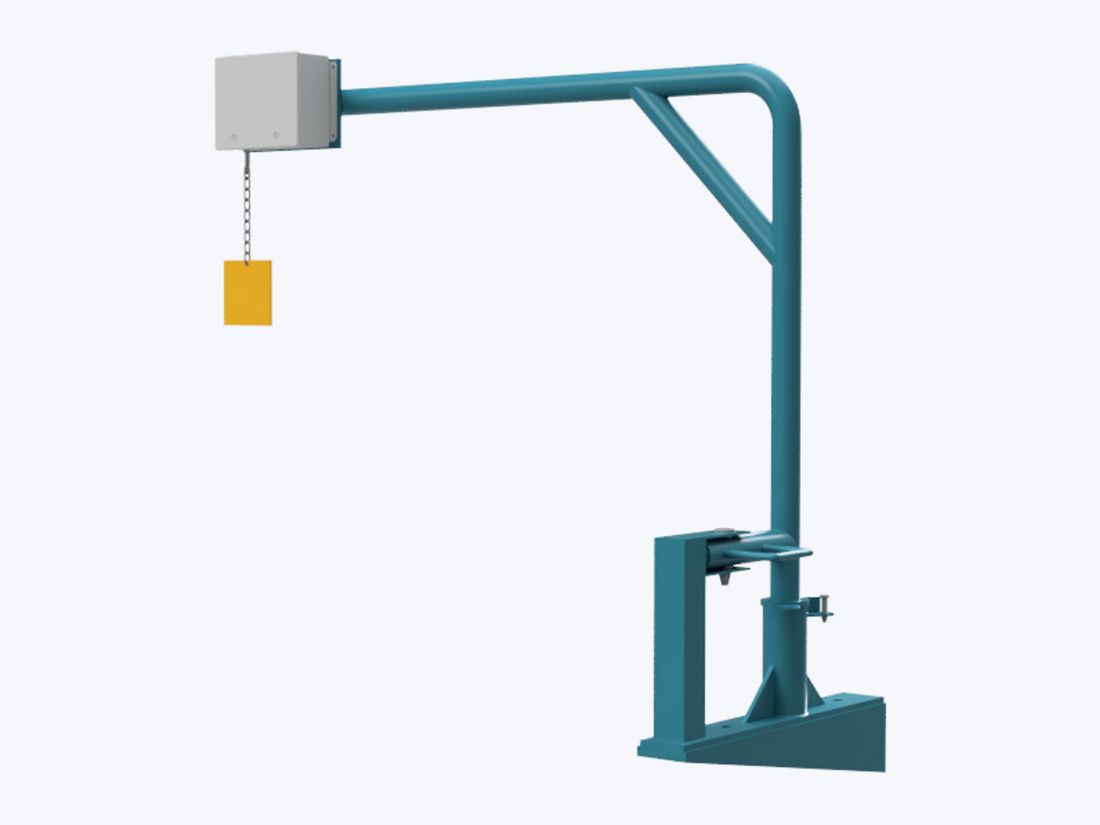
Automated calibration arm
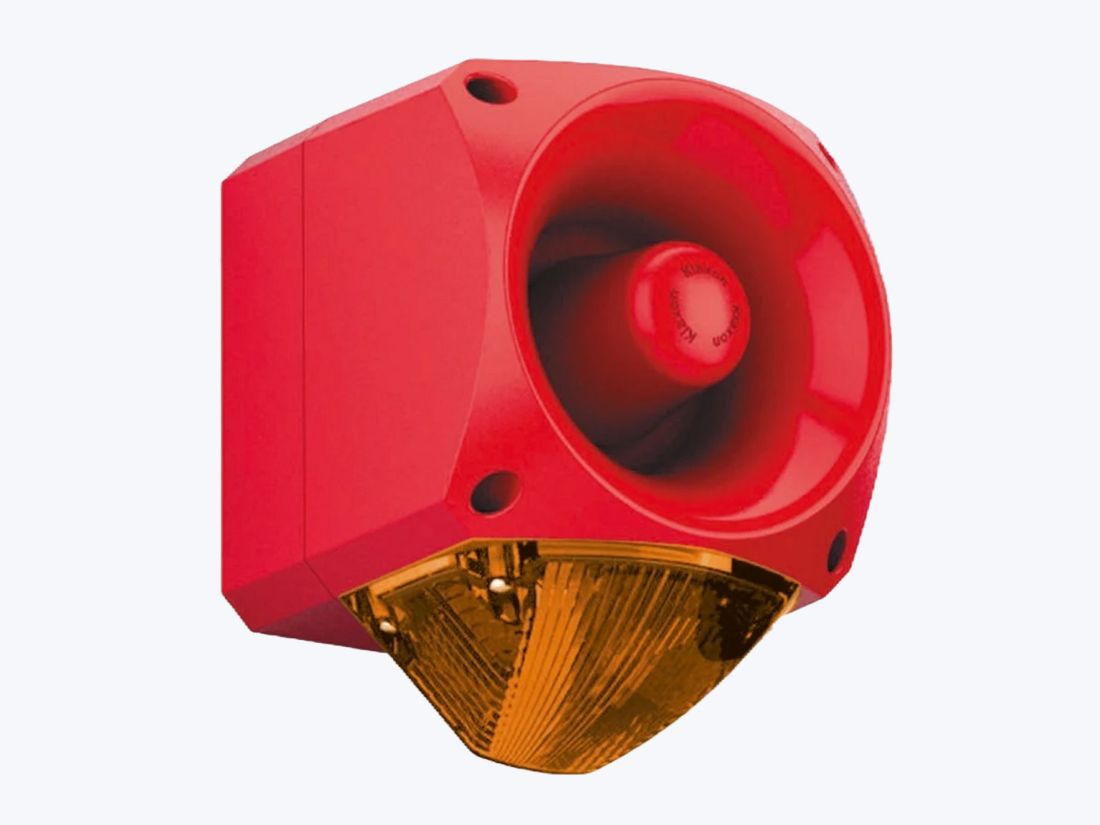
Sounder / beacon
Sounder / beacon
Tramp metal detector · Patent pending

A pulse-induction tramp metal detector that sees ferrous and non-ferrous tramp inside the ore profile, such as bucket teeth, drill rods, skirt plates and scaffold tube, on ores with high magnetic permeability and conductivity that swamp conventional detectors.

  • 10.1″ sunlight-readable touchscreen with live signal trace, trip and coast counts and a retrieval-frame reference to locate the tramp
  • Guided calibration: idle-baseline learning, test-piece capture and Auto Win window scan
  • Modbus TCP / RTU integration block with communications watchdog; diverter-gate mode for belts that keep running
  • Self-correcting baseline tracks thermal drift and re-centres within 30 s after a long stop
0.05–9.5 m/sBelt speed
700–3000 mmBelt width
IP66Controller

TripTronic 3000 in detail: components, options, installation, operation

What it detects

Ferrous and non-ferrous tramp within the ore profile: bucket teeth, skirt plates, drill rods, scrap steel left after shutdowns, tools and scaffold tubing. Proven on iron ore, coal, lithium, manganese, aggregates and coke, including highly conductive and magnetically permeable ores that swamp conventional detectors.

System components

  • TMD frame and coils. Engineered adjustable frame in non-conductive, impact-resistant PVC, hot-moulded and FEA-tested for cyclonic conditions. Transmitter coil above the carry strand, receiver coil below; coils CNC-routed into PVC plates and sealed in epoxy, with a 35° contoured receiver to focus the secondary field.
  • Controller. Mother board with Ethernet, power board and display board in an IP66 thermoplastic enclosure inside a stainless steel B&R cabinet. NORMAL, ALARM and BYPASS LEDs and a bar graph visible from outside; exterior weatherproof RESET button.
  • 10.1″ touch screen. Sunlight-readable operator interface with Run, Setup, Options, Calibration, Service and View menus and three password levels (User, Administration, Service Technician).
  • Balance actuator. 24 VDC, 3000 N linear actuator that tilts the transmitter coil for coil balance from the screen.

Options

  • Flag Drop Marker. Timed output drops a flag on the belt at the detection point, coordinated with belt speed, so the tramp is found quickly.
  • Speed sensor. For variable-speed belts; accurate coast distance and marker/clip timing (input to 2.5 kHz).
  • Clip detector. Momentarily reduces sensitivity as belt repair clips or mechanical joins pass.
  • Sounder / beacon. Audible and visual alarm at the detector.
  • Automated calibration arm. Passes a test piece through the aperture on demand.
  • Diverter gate mode. For sites where a gate or tramp magnet removes the metal and the belt keeps running: detection operates the output for the gate cycle and re-arms automatically.

Plant integration

Modbus TCP over Ethernet (port 502) or Modbus RTU on RS485. A contiguous 71-word integration block with alarm status bits, trip and coast counts, live signal and a communications watchdog is provided for PLC/SCADA. Alarm, bypass and remote-reset can also be hard-wired to the plant.

Installation

  • Frame suits 700–3000 mm belt widths; height adjustable 1060–1560 mm; belt must track true through the aperture.
  • No idlers, moving parts or vibrating structure inside the exclusion zone around the coils (distances on the installation drawings).
  • Coil wiring in a separate conduit from power wiring; controller supply 90–264 VAC.
  • Customer terminals for alarm relays, marker output, remote reset, bypass and speed sensor per the field wiring diagram.

Commissioning

Balance the coils, learn the idle baseline (static, running empty, running loaded), capture the test piece with Arm Metal, then let Auto Win scan transmitter power and detection-window combinations for the best signal-to-noise margin. Sensitivity is set last, and the self-correcting baseline holds the calibration through thermal drift and long belt stops. Veytech can commission on site or support your electricians remotely.

Common questions

Will it trip on the belt splices? Magnetised steel-cord splices are the most common cause of false trips. The detector's learned baseline and clip handling manage most cases; where splice flux is high, FluxRite mkII removes it at the source.

What is the smallest piece it will detect? That depends on coil separation, belt speed, burden and ore. Detection is verified on site with an approved test piece at operating belt speed. Talk to us about your target size.

Can it run on a variable-speed conveyor? Yes, with the speed-sensor option; marker and coast calculations follow the measured speed.

What happens if the controller overheats? Over-temperature protection raises a warning at 85 °C and a critical alarm at 95 °C that inhibits outputs until the unit cools.
TripTronic 3000 price guide (list prices, AUD ex GST)

List prices for budgeting. Every system is quoted to the site data sheet; freight, installation and commissioning are quoted separately. Prices subject to change without notice.

Complete system by belt width

TMD frame, transmitter and receiver coils, balance actuator and controller with 10.1″ touch screen.

Belt widthList price
Up to 1050 mm$31,742
Up to 1350 mm$36,240
1500 mm$39,661
1600 mm$40,835
1800 mm$42,335
2000 mm$46,385
2200 mm$45,557
2400 mm$48,405
2600 mm$51,315
3000 mm$56,387

Options

ItemList price
Flag Drop Marker, 240 VAC or 24 VDC$3,370
Flag Drop Marker swinging mounting frame$8,125
Flag Drop Marker fixed mounting frame$1,700
Clip detector (each)$1,055
Sounder / beacon, 240 VAC or 10–60 VDC$1,075
Junction box, standard stainless$2,249
Junction box, stainless with brass gland plate$4,489
Pilbara X15 orange enclosure with brass gland plate (controller upgrade)$17,795
Belden 8760 screened coil cable, per metre$67.50
Clip detector cable 0.75 mm² 3C+E, per metre$32.78

Spare parts

PartList price
Controller, complete (VEY-TT-MC-01)$15,301
Transmitter coil 600–1050 mm$1,870
Transmitter coil 1200 mm$2,035
Transmitter coil 1500 / 1600 / 1800 mm$2,406 / $2,500 / $2,688
Transmitter coil 2000 / 2200 / 2400 mm$2,875 / $3,063 / $3,250
Transmitter coil 2600 / 3000 mm$4,500 / $5,500
Receiver coil 600–1050 mm$2,738
Receiver coil 1200 / 1500 / 1600 mm$3,400 / $4,400 / $4,605
Receiver coil 1800 / 2000 / 2200 mm$5,018 / $5,428 / $5,840
Receiver coil 2400 / 2600 / 3000 mm$6,250 / $5,660 / $7,483
Coil balance actuator (VEY-ACT-50-24)$127
Flag, complete with pin (VEY-FDM-FG-02)$234

Get a configured quote

TripTronic 3000 · How it works

Ore decays fast. Tramp decays slowly. The TripTronic measures the difference.

  1. PulseThe transmitter coil above the belt fires a short electromagnetic pulse into the ore stream.
  2. Switch off and readWhen the pulse stops, eddy currents keep circulating in anything conductive. The receiver coil below the belt senses the secondary field they produce.
  3. Wait out the oreThe ore's field collapses in microseconds. The tramp metal's field persists. The controller measures only in a late window after the ore has gone quiet.
  4. Compare with the learned baselineThe controller has already learned what the empty and loaded belt look like in that late window. It subtracts that baseline from what it sees now and ignores small changes. Anything left over is metal. When it rises above the trip level the belt stops, and the controller tells you how far the belt travelled so the tramp can be found and removed.
Ore backgroundTramp metalEarly reference windowLate detection window
TripTronic 3000 · Specifications

Built for harsh mine site conditions.

Controller

Operating temperature−40 to +85 °C
EnclosureIP66
Belt speed0.05 – 9.5 m/s
Supply90–264 VAC 48–62 Hz
Power480 W
Outputs24 VDC / 240 VAC
CommsModbus TCP · RTU

Touch panel

Screen10.1″ 1024 × 600
SurfaceAnti-glare
Luminance450 cd/m²
Operating temperature−20 to +70 °C
LanguagesEN · ES · DE · IT · FR · ZH

TMD frame & coils

Belt width700 – 3000 mm
Frame height1060 – 1560 mm
MaterialHot-moulded PVC
CoilsCopper, PVC encased
Balance actuator24 VDC · 3000 N
OptionsSpeed sensor · Clip detector · Flag Drop Marker · Sounder

Size a system for your conveyor.

Fill in the online data collection sheet and get an instant budget estimate at list prices, or download the printable PDF for site.